Local SEO for Trades: How to Get More Local Enquiries
A practical guide for plumbers, tilers, renderers, roofers, bathroom fitters, electricians, builders and similar local trades. Covering Google Business Profile, service pages, location pages, reviews, photos, internal linking and tracking — the building blocks that turn local searches into real enquiries.
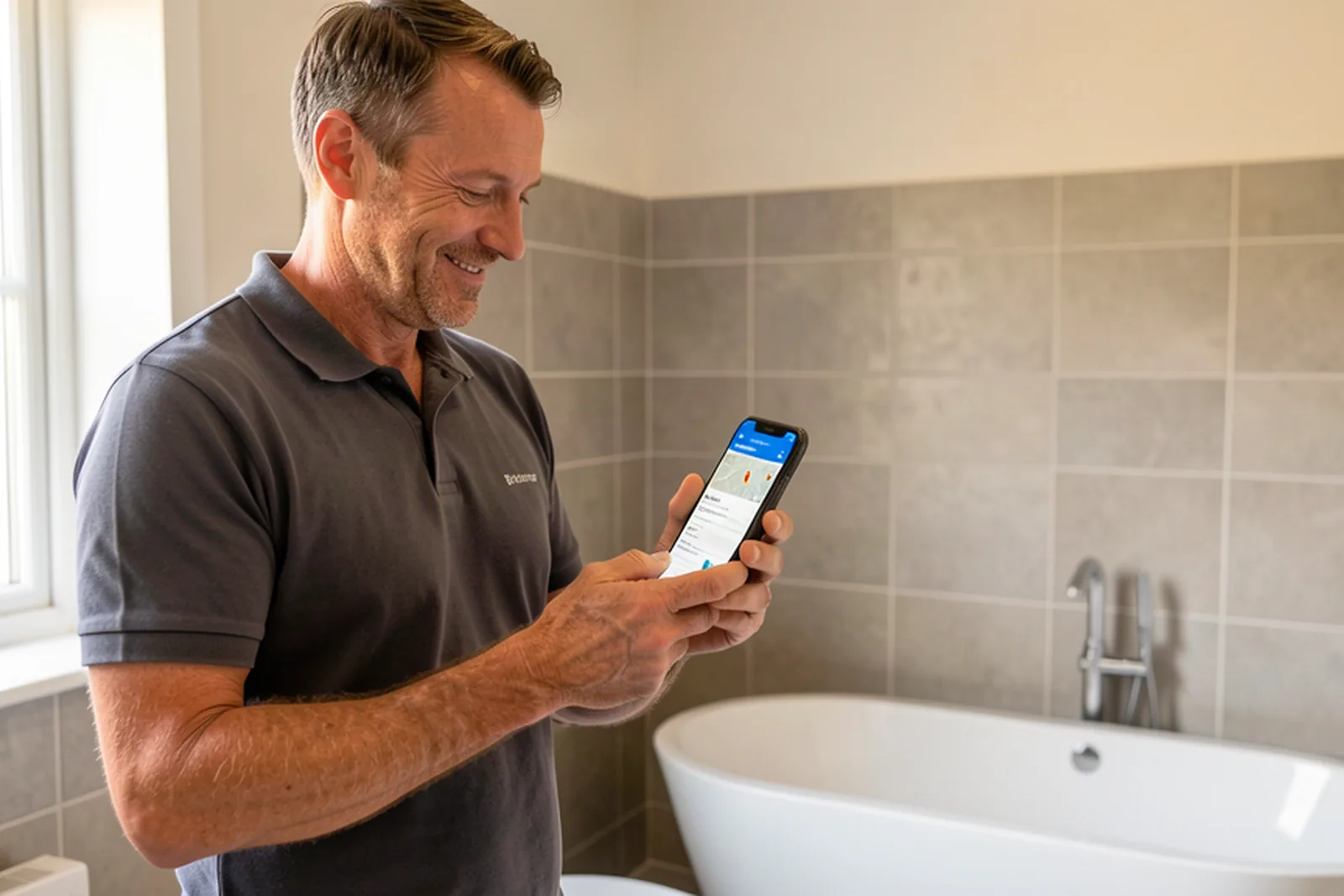
If you run a trade business, most of your customers are not searching nationally. They are searching locally — “plumber near me”, “bathroom fitter Cwmbran”, “roofer Neath”. Local SEO is how you make sure they find you instead of the competition. This guide covers the practical building blocks, in plain English, with no jargon and no fake guarantees.
It is written for plumbers, tilers, renderers, roofers, bathroom fitters, electricians, builders and similar local trades — but the same principles apply to any service business that serves customers in a specific area.
Trades this guide covers
What local SEO means for trades
Local SEO is the process of making your business visible in Google search results when people in your area search for the services you offer. Unlike national SEO, which competes for broad terms like “best boiler” or “how to tile a floor”, local SEO targets the searches that come with intent to hire someone nearby — “plumber Cardiff”, “roof repairs Swansea”, “bathroom fitter near me”.
For trades, this matters because your customer base is geographic. A plumber in Newport does not need someone in Newcastle to find them. They need the person in Newport, or Cwmbran, or Caerphilly, who has a leaking pipe and a phone in their hand. Local SEO is what puts your business in front of that person at the moment they are ready to call.
The core building blocks are straightforward: a website that clearly describes what you do and where you work, a Google Business Profile that is complete and accurate, customer reviews that build trust, and a site structure that helps Google understand the relationship between your services and your locations. You can read more about the full service approach on the main local SEO page.
Google Business Profile basics
Your Google Business Profile is one of the highest-impact assets you have for local search. It is what appears in the Map Pack — the block of three local business listings that shows at the top of Google search results with a map — and in Google Maps results. For many local trade searches, the Map Pack captures the largest share of clicks.
If you do not have a profile yet, start there. If you have one, check the basics:
- Verified ownership. Google needs to confirm you are the business owner. Without verification, your profile will not appear in local results.
- Accurate categories. Your primary category should match what customers actually search for. “Plumber” is better than “Heating contractor” if people search for plumbers. Add secondary categories for related services you offer.
- Services and service areas. List the services you offer and the towns or postcodes you cover. This tells Google where to show you.
- Consistent NAP. Your business name, address and phone number must match exactly across your website, your Google profile and local directories. Inconsistencies confuse Google and weaken your local ranking signals.
- Photos. Add a logo, a cover image and real photos of your work. Profiles with photos get more clicks and more enquiries.
- Regular posts. Google Business Profile posts let you share updates, offers and recent work. They signal that your business is active.
An optimised profile is the single fastest win for most trade businesses. If you want help setting it up or auditing an existing one, that is part of the local SEO service.
Service pages
A service page describes one specific service you offer. Instead of cramming “plumbing, heating, bathrooms, boilers, emergency callouts” onto a single homepage, you create a dedicated page for each. This gives Google a clear signal about what each page is about and gives your visitor a page that speaks directly to their need.
A good service page includes:
- A clear H1 that names the service — for example, “Bathroom Fitting in Cwmbran”
- What the service involves and what customers can expect
- Which areas you cover for that service
- Photos of relevant completed work, if you have them
- A clear call to action — phone number, contact form or WhatsApp link
Thin, generic pages do not rank. Each service page should have genuine, useful content that answers the questions a customer would ask before hiring you. If you need a new site built with proper service page structure from the start, the web design service builds local SEO in from day one. For trade-specific approaches, see websites for tilers and web design for plumbers. Not sure what a trade website should include? The website content checklist for trades breaks down the pages and features that matter.
Location pages
A location page targets a specific town or area you serve. If you cover Cardiff, Newport, Bridgend and Cwmbran, you should not try to rank one page for all four. Separate location pages — each with genuine, useful content about serving that area — give Google clear signals and give customers a page that speaks directly to them.
A useful location page is not just a renamed template. It should include:
- The town or area name in the H1 and page title
- The services you offer in that area
- Genuine content — not the same paragraph with a different town name swapped in
- Internal links to your relevant service pages
- A clear call to action
The mistake to avoid is creating thin, duplicate location pages that differ only by town name. Google can detect that pattern and it does not help you. Each location page should earn its place by being genuinely useful to a customer in that area.
For a real example of how service and location pages work together, the AMJ Tiling case study shows how a bathroom fitter went from no online presence to page 1 rankings across 11 local areas in under two months — no ads, just local SEO done properly.
Reviews
Reviews are one of the strongest local ranking factors and one of the strongest trust signals for potential customers. A business with 40 genuine five-star reviews will usually out-rank and out-convert a business with 5 reviews, all else being equal.
The practical approach is simple:
- Ask happy customers for a review when the job is done — while the experience is fresh
- Make it easy: send a direct link to your Google review page
- Respond to every review, positive and negative, professionally and promptly
- Never buy reviews or offer discounts in exchange for them — Google can detect and penalise both
You do not need hundreds of reviews overnight. A steady, genuine stream of reviews from real customers builds trust and signals to Google that your business is active and valued in your local area.
Photos and project proof
Trades sell trust. Before someone hires you, they want to see that you have done this kind of work before and done it well. Photos of completed projects — on your website and on your Google Business Profile — are one of the most effective ways to demonstrate that.
What works:
- Before and after photos where relevant — bathrooms, render, extensions, decorating
- Real photos of real jobs, not stock images
- Short captions that explain what the job involved
- Photos added to your Google Business Profile as well as your website
Beyond trust, photos also help with image search and give Google more context about your business and services. A page with genuine project photos and descriptive alt text is stronger than a page with none.
Internal linking
Internal links are the links between pages on your own website. They help Google understand how your pages relate to each other and which pages are most important. They also help visitors find related information without leaving your site.
For a trade website, a good internal linking structure looks like this:
- Your homepage links to your main service pages
- Each service page links to the location pages where you offer that service
- Each location page links to the services you offer in that area
- Every page links to your contact page or a clear call to action
- Relevant pages link to each other in context — not a generic footer link dump
The goal is to make it easy for Google to crawl your site and understand that, for example, “bathroom fitting” and “Cwmbran” are connected on your site. Contextual links within your page content are stronger than a list of links in a footer.
Tracking enquiries
Rankings are only useful if they turn into enquiries. If you do not know where your enquiries come from, you cannot tell what is working and what is not. The first step is simply to ask every new caller or emailer how they found you — “did you search on Google, see us on Facebook, or were you recommended?” That alone gives you more useful data than most small businesses have.
Beyond that:
- Use a contact form that records the page the visitor came from
- Set up call tracking if you want to know which keywords drive phone calls
- Connect Google Analytics and Google Search Console to see which pages get traffic
- Track your Google Business Profile insights — calls, direction requests and website clicks
You do not need complex tools to start. A simple spreadsheet that logs each enquiry and its source will tell you within a month or two whether your SEO work is generating real leads — and which pages or areas are worth more focus.
Common mistakes
Most trade websites I audit are held back by the same handful of issues. Here are the most common ones — and they are all fixable. If your website is getting traffic but no enquiries, many of these overlap with the problems covered in why websites fail to generate enquiries.
See how AMJ Tiling got found on Google
From zero online presence to showing up in Google Maps and getting organic enquiries in under 2 months — no ads, just local SEO done properly.
About 20 hours of work
That is all it took to get a local bathroom fitter showing up in searches, appearing in Google Maps, and getting real enquiries — all organic, not pay-per-click.
"If he stopped today, the results continue... because it is all organic, not pay-per-click."
How Hello Website can help
If you want local SEO done for you — or you want a website built with local SEO from day one — here is where to start.
Local SEO services
Google rankings, Google Business Profile, Map Pack visibility, technical SEO, content and reporting — the full service for trades and small businesses.
Find out moreLocal SEO South Wales
Local SEO support specifically for trades and small businesses across South Wales — Cardiff, Newport, Bridgend, Cwmbran, Caerphilly, Swansea and nearby areas.
Find out moreWeb design for trades
Fast, mobile-friendly websites built with local SEO from the start — service pages, location pages, schema markup and a clear internal linking structure.
Find out moreFrequently Asked Questions
Common questions about local SEO for trades.
What is local SEO for trades?
How long does local SEO take to work for a trade business?
Do I need a Google Business Profile if I already have a website?
What is the difference between a service page and a location page?
Can I do local SEO myself?
Want more local customers finding you on Google?
Get a free, no-obligation SEO analysis report for your website — or get in touch to discuss your trade and what you want to achieve.